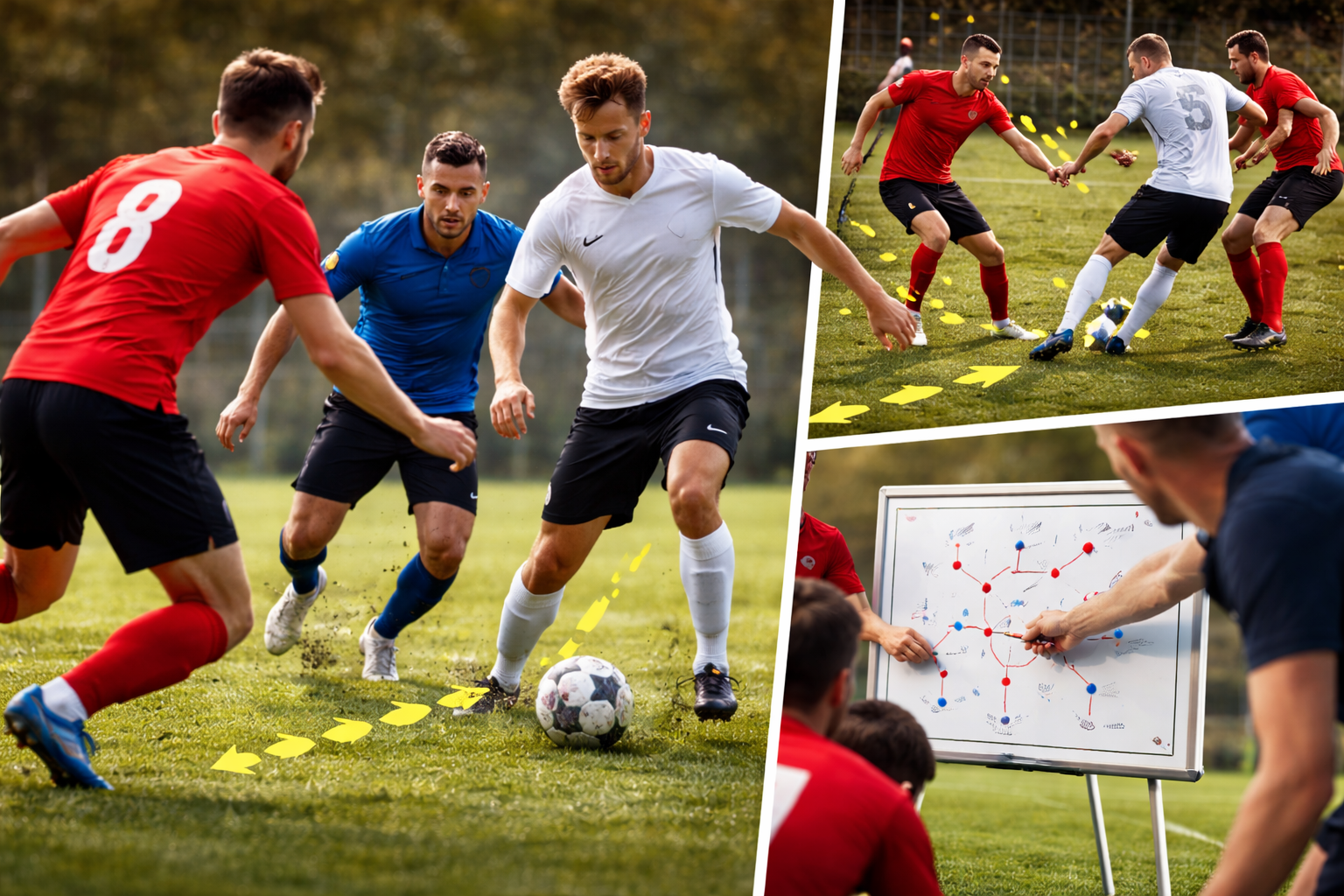
Pressing is the sport’s loudest form of defending. It is a decision to hunt, not to wait. One team steps forward as a unit, cuts passing lanes, and tries to win the ball on purpose, in a place that suits them.
Fans feel it before they can name it. The stadium volume climbs. A center back takes one extra touch. A fullback checks his shoulder and finds a winger already sprinting at his first touch. Then the ball pops loose and the whole phase flips in two seconds.
Pressing looks like chaos from far away. Up close, the best versions run on rules. Coaches build those rules around three questions.
Where do we want the opponent to play?
When do we jump, and when do we hold?
Who covers the space behind the press?
Answer those well, and pressing stops being a gamble. It turns into a repeatable way to control matches.
Pressing is a map, not a mood
A good press starts with shape. Your formation gives you the first draft of your coverage.
A 4-3-3 can press with three forwards across the back line. It can lock the ball on one side and force long passes. A 4-4-2 often presses with two strikers and uses the wide midfielders to spring traps. A 3-4-3 can press high with numbers, then protect the center with three defenders behind the ball.
The shape matters less than the spacing. Most top teams keep 8 to 12 meters between lines during a press. They stay close enough to win second balls, and close enough to counter-press right after losing it.
High press, mid-block press, low block: three gears, same idea
Pressing is not only “go high.” It is a set of gears.
High press starts near the opponent’s box. It aims for quick wins, fast shots, and forced clearances. It demands brave defending in space.
Mid-block press starts near the center circle. It invites passes into certain lanes, then snaps shut. It trades some chaos for control.
Low block with pressure defends deep, then presses hard on the first pass out. It bets on compactness, then speed.
Top sides switch gears inside the same match. They press high after a goal kick, then drop into a mid-block once the opponent settles.
Triggers: the green lights that start the hunt
Players do not sprint at every touch. They look for triggers. Triggers are moments that tilt the odds.
Common triggers include:
- A pass into a fullback facing his own goal
- A center back taking a heavy touch
- A square pass across the back line
- A goalkeeper receiving the ball under pressure
- A pass into a marked defensive midfielder
- A bouncing ball that forces an awkward first touch
- A throw-in near the sideline
- A bad body angle that kills forward options
The best presses hit on the trigger, not after it. If you arrive late, the opponent plays through you and the whole plan looks silly.
Angles and shadows: the part fans miss on TV
Most pressing work happens without tackles. It happens through angles.
A presser does two jobs at once. He runs at the ball, and he blocks a pass lane with his body. Coaches call that lane-blocking “cover shadow.” It sounds fancy, but it is simple. Your run should remove one pass option, so the ball carrier has fewer safe choices.
Picture a winger pressing a fullback. The winger does not sprint straight at him. He curves the run so the inside pass into midfield disappears. The fullback sees only the line down the sideline, or the risky ball back inside.
That is the whole point. Pressing is about forcing the next pass, not winning the current touch.

Pressing traps: how teams “invite” the pass they want
A trap is a planned invitation. You show the opponent a pass that looks safe, then you punish it.
A classic trap targets the sideline. The sideline acts like an extra defender. Once the ball arrives wide, three things happen fast.
- The nearest player attacks the ball
- A second player blocks the line down the wing
- A third player blocks the pass back inside
Now the ball carrier has no easy exit. He plays long, or he loses it.
Teams set traps in other places too. Many presses bait passes into the No. 6 area, then collapse with two midfielders and a striker. Others bait the switch, then sprint to arrive on the receiver’s first touch.
Counter-pressing: the five-second fight after you lose it
Counter-pressing starts the moment possession ends. It is the quickest way to defend, since the opponent has not shaped up yet.
Many coaches use a simple rule: win it back inside five seconds. If the team cannot win it in that window, they drop into their next defensive shape.
Counter-pressing works best with tight spacing. If your players sit 20 meters apart in attack, you cannot counter-press. The ball flies past one presser and the opponent runs into open grass.
This is why elite teams talk about “rest defense.” Rest defense means the shape you keep behind the attack. It is not passive. It is a safety net that lets you press again.
Roles by position: who does what in a real press
Pressing fails when everyone chases the ball. It succeeds when each role stays clear.
Strikers set the direction. They choose the side to force. They screen the pass into the defensive midfielder.
Wingers jump to fullbacks and press on the outside shoulder. They force play into traps and win throw-ins.
Midfielders protect the center. They step up to intercept passes into feet. They cover runners behind the press.
Fullbacks decide the risk. They can jump to a winger high up the pitch, or hold a deeper line. Their decision changes everything behind them.
Center backs hold the line and win the long ball. They must defend space with calm timing, not panic.
Goalkeepers act as sweepers. They clean up balls over the top and reset possession quickly.
Pressing looks most impressive up front, but the back line makes it possible.
What changes from league to league
The idea stays the same across competitions, but context shifts the details.
In leagues with fast transitions and direct play, teams press with more caution. They fear the first ball over the top and the second ball chaos. In leagues that build patiently, teams press with more structure. They can bait predictable patterns and spring traps with timing.
Weather and pitches matter too. A wet surface speeds up passes and first touches. That creates more pressing triggers. A slow surface gives the ball carrier extra time, so the press needs tighter spacing.
The stats that hint at pressing strength
Fans love a hard sprint, but coaches track outcomes.
- PPDA measures passes allowed per defensive action. Lower often signals more pressure.
- High turnovers count wins in the attacking third.
- Field tilt shows territory and sustained pressure.
- Ball recoveries show how often a team regains possession after losing it.
Numbers do not prove quality on their own. A wild press can post “good” volume and still concede easy goals. Use stats as clues, then watch the spacing and the triggers.
How pressing breaks, and how teams fix it
Pressing breaks for three common reasons.
The first is a gap between lines. One player jumps and the line behind stays put. The opponent plays into that gap and turns.
The second is poor weak-side coverage. Everyone stares at the ball side, and a switch finds a free winger.
The third is fatigue. Pressing costs energy, and tired legs arrive late. Late arrivals equal fouls, missed tackles, and broken shape.
Teams fix these issues with discipline, rotation, and smarter gear changes. They press hard in short bursts, then drop into a mid-block to breathe, then strike again on the next trigger.
Final whistle
Pressing is not just running more. It is running with a plan, and with teammates close enough to share the work. When you see a forward curve his run, watch what he removes. When a winger sprints at a fullback, watch the midfielder stepping up behind him. When the ball pops loose, notice how many shirts arrive at once.
That is why the best pressing teams feel inevitable. They do not hope for mistakes. They manufacture them.