A match often turns on the midfield. The ball spends long stretches there. Space opens there. Pressure starts there.
The midfielder role soccer coaches teach is simple to say. Win the middle. Connect the team. Control the match tempo. The work is hard, and it never stops.
Midfielders defend and attack in the same minute. They protect the back line, and they feed the front line. They read danger early, then they create chances fast. That blend sits at the heart of football tactics.
Why the midfield matters more than most positions
A striker can score twice and still touch the ball 25 times. A midfielder can touch it 80 times and shape every phase. One extra touch can slow a counter. One first-time pass can break a press.
Midfielders decide where the match lives. They can keep play central, or they can push it wide. They can speed the game up, or they can slow it down. They can drag markers out, then open lanes for runners.
Teams that win midfield battles win second balls. They win field position. They win the next pass after a tackle. Those small wins stack up over 90 minutes.
Core duties every midfielder shares
Roles change by system, but the base job stays steady. A top midfielder does these things every match:
- Offer a safe passing angle for teammates
- Receive under pressure with a clean first touch
- Play forward early when the lane is open
- Switch play to escape pressure
- Track runners through the middle third
- Screen passes into the striker
- Press with timing, then recover shape
- Lead the counterpress after losing the ball
These are not bonus skills. They are the job. A midfielder who skips one area forces others to cover.
The hidden skill: scanning
Midfielders live on information. They scan before the ball arrives. They scan after the first touch. They scan during every run.
Scanning answers three questions:
- Where is the nearest pressure?
- Where is the next pass?
- Where is the space for the next action?
A midfielder with constant scanning plays faster with less risk. The touch looks calm, but the mind works fast.
Types of midfielders and what they do
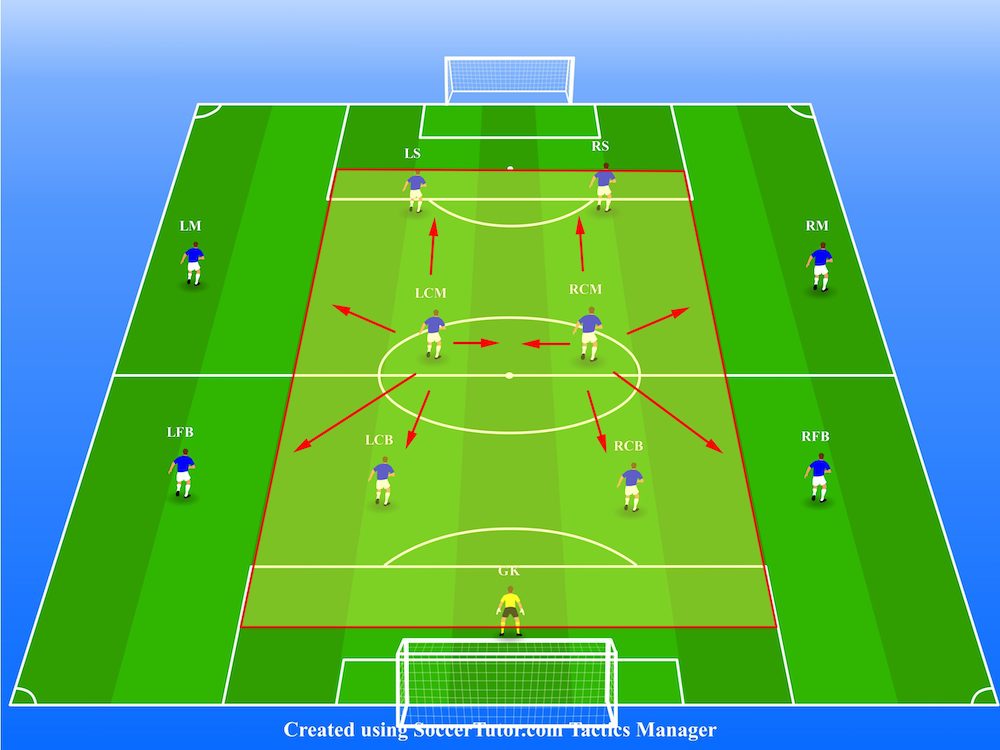
Coaches use many labels, but most roles fall into clear groups. These are the main types of midfielders you see in modern football tactics.
Defensive midfielder
The defensive midfielder protects the center. They sit in front of the back four. They block passes with their feet. They cover fullbacks when they step out.
Key actions:
- Screen the striker and the number 10
- Win second balls near the center circle
- Tackle in front of the box, not inside it
- Play simple passes to start attacks
A strong defensive midfielder makes the team harder to play through. They stop counters at the source.
Deep-lying playmaker
This player runs the game from deep areas. They receive from center backs. They turn pressure into space with one pass.
Key actions:
- Show early for the first build pass
- Hit diagonal switches to the far wing
- Split lines with firm ground passes
- Set match tempo with pass choice
This midfielder often looks slow. Their impact is speed, but it is speed of decision.
Box-to-box midfielder
This is the engine role. They cover huge distance. They join attacks, then sprint back to defend.
Key actions:
- Arrive late in the box for cutbacks
- Track runners into the penalty area
- Win duels in midfield traffic
- Carry the ball through pressure zones
A top box-to-box player gives a team an extra body in both boxes. They make the shape flexible.
Advanced midfielder
This player works between lines. They link midfield to attack. They thrive in tight spaces near the box.
Key actions:
- Receive on the half-turn near the D
- Slip through balls to runners
- Combine with quick one-twos
- Draw fouls in dangerous zones
This role demands sharp touch and fast thinking. It demands courage too. The pressure comes from all angles.
Wide midfielder
In a 4-4-2 or similar shape, wide midfielders must do two jobs. They support attacks out wide. They defend the flank with the fullback.
Key actions:
- Track the opposition fullback on overlaps
- Press wide to trap play near the sideline
- Cross early, or cut inside to combine
- Offer an outlet pass under pressure
This role asks for discipline. A wide midfielder who switches off exposes the fullback fast.
How roles change by system
Formations change responsibilities. The midfield stays the control room, but the tasks shift.
4-3-3
This shape often uses a single pivot and two number 8s. The pivot protects the back line. The 8s press, carry, and arrive.
Common patterns:
- Pivot drops between center backs in build play
- One 8 supports wide overloads
- One 8 arrives late for shots near the box
4-2-3-1
This shape uses a double pivot and a number 10. The pivot pair shares defensive work. The 10 links and creates.
Common patterns:
- One pivot step to press, one holds
- The 10 finds pockets behind the midfield line
- Wingers tuck in, then fullbacks provide width
3-5-2
This shape often uses three central midfielders. One holds. Two shuttles. Wingbacks cover the width.
Common patterns:
- Central trio controls the middle with numbers
- Shuttlers cover half-spaces and support wingbacks
- Holding midfielder protects the space in front of the three center backs
System choice changes running loads and passing angles. It also changes who must cover wide zones.
Midfield works in each phase of play
Midfielders do not play one game. They play four phases, and each phase has rules.
Build-up
Midfielders must offer angles. They must receive under pressure. They must help the team escape the first press.
Strong build-up habits:
- Check the shoulder, then receive on the half-turn
- Use one-touch passes to beat pressure
- Drop into pockets near the center backs
- Move the ball away from pressure, then attack the new space
Attack
In attack, midfielders connect and threaten. They keep the ball moving. They make runs that pull markers away.
Strong attacking habits:
- Play forward passes early, then support for the return
- Rotate positions to confuse markers
- Arrive late at the top of the box for rebounds
- Protect rest defense with smart spacing behind the ball
Defense
In defense, midfielders set the line. They stop the first pass forward. They protect the space in front of center backs.
Strong defensive habits:
- Stay compact between lines
- Track runners through the middle channel
- Press in pairs, not alone
- Force play wide, then lock the sideline trap
Transition
Transitions decide matches. Midfielders live in transition moments. They either start a counter or stop one.
Strong transition habits:
- Win the first duel after loss
- Counterpress for five seconds, then recover
- Play the first forward pass on counters
- Take smart fouls in safe zones when needed
The skills that separate good from elite
Many players run. Many players tackle. Elite midfielders add layers.
First touch that sets the next action
A midfielder’s first touch should solve a problem. It can move away from pressure. It can open a passing lane. It can set a shot.
The best touch is not fancy. It is useful.
Passing weight and timing
A pass that arrives late kills the move. A pass hit too hard breaks control. Midfielders must match weight to distance and tempo.
Good midfield passing has rhythm. It has purpose. It creates a next step.
Body shape and balance
Midfielders win time with posture. They receive side-on. They keep knees bent. They stay ready to turn both ways.
This helps under pressure. It helps in duels. It helps in quick combinations.
Communication and leadership
Midfielders see the whole shape. They talk more than most. They point, call, and organize.
A quiet midfield often means a loose team. A vocal midfield often means a compact team.
Common mistakes midfielders make
These errors show up at every level. Fixing them raises match impact fast.
- They stand flat and give no angle for a pass
- They watch the ball and stop scanning
- They chase the ball and break team shape
- They force risky passes into crowded lanes
- They press alone and get played around
Each mistake has a simple cure. Better spacing. More scanning. More patience. More teamwork in pressing.
What coaches look for in the midfielder role soccer teams rely on
Coaches praise goals and assists, but they select midfielders for control. They want reliability under pressure. They want smart defense. They want the player who makes teammates better.
A coach looks at:
- Decision speed under pressure
- Ability to play forward with low risk
- Work rate in recovery runs
- Discipline in team shape
- Influence on match tempo
These traits win minutes. They win roles in strong teams.
The midfield is the match
Football tactics start in the middle. The best teams control space there. The best midfielders control time there.
A midfielder does not need headlines to decide a match. They need repeat actions done well. They win duels. They connect passes. They guide the tempo. Then the rest of the team plays with confidence.