Talent draws attention. Conditioning wins possessions in the fourth quarter.
A competitive basketball player covers up to three miles in a game. He performs dozens of short sprints, sharp cuts, and repeated jumps. Heart rate spikes near maximum, drops during brief pauses, then spikes again. This pattern repeats for 40 or 48 minutes.
Basketball conditioning must reflect that reality. Straight-line jogging will not prepare an athlete for playoff tempo. The body must learn to sprint, recover, and sprint again without a drop in skill.
What the Game of Basketball Demands
Most live game sprints last two to four seconds. Distances range from 10 to 30 meters. A guard may explode off a screen, retreat on defense, then cut back door within 15 seconds. That sequence stresses both anaerobic and aerobic systems.
Data from performance tracking shows elite players can perform 40 to 60 high-intensity efforts per game. Many of these occur in clusters. A fast break, a defensive rotation, and a rebound battle can happen within one possession.
Acceleration matters more than top speed. The first three steps decide separation. Lateral movement determines defensive stops. Players change direction at angles of 45 to 180 degrees. Ankles, knees, and hips absorb repeated force.
Vertical power remains constant across positions. A forward may jump 20 to 30 times in a game. Each jump places stress on the lower body. Fatigue reduces jump height by several inches late in games if conditioning is poor.
Stamina training basketball programs must address:
- Repeat sprint ability under short rest
- Quick deceleration and re-acceleration
- Lateral slides at game speed
- Jump performance that holds steady in the fourth quarter
If a player slows by even half a step, passing lanes close and driving gaps disappear.
Conditioning must prepare the athlete to execute the skill at full speed. Shooting percentage often drops late in games. Turnovers rise. Those trends link directly to fatigue.
On Court Cardio Drills That Carry Over
The best cardio drills look like live play.
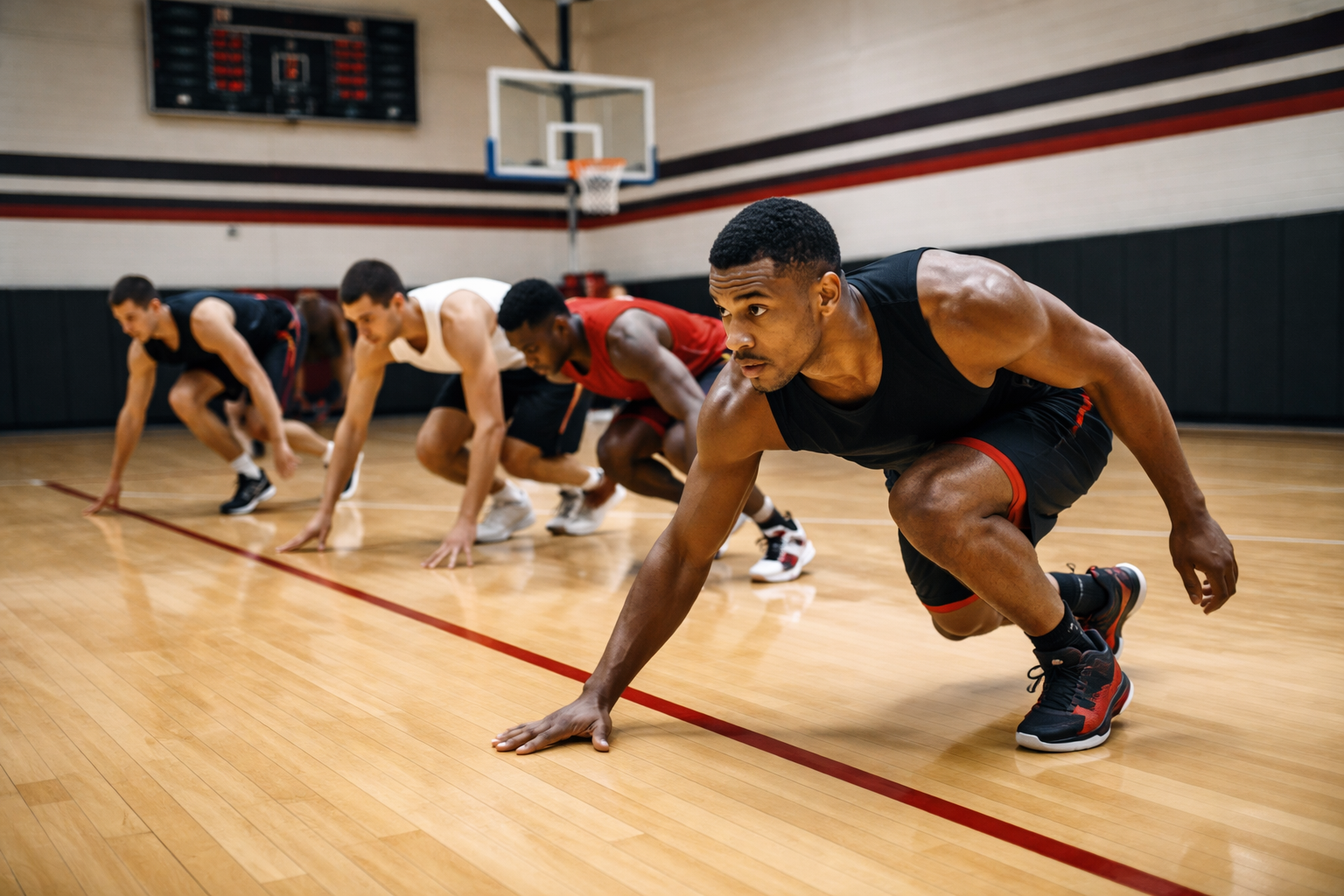
Suicide runs remain a standard. Sprint baseline to free throw line and back. Then half court and back. Then opposite the free throw line and back. Finish full court and back. One rep takes about 30 seconds. Rest 30 seconds. Complete six to ten reps. Record every time.
The 17 drill tests speed and discipline. Run sideline to sideline 17 times in under 60 seconds. Rest one minute. Repeat three to five rounds. Times must stay within two to three seconds across rounds.
Three man weave blends conditioning with skill. Players sprint the length of the floor, pass on the move, and finish with a layup. Rotate continuously for four minutes. Missed layups trigger short penalties. Fatigue cannot excuse poor execution.
Defensive closeout circuits train effort on tired legs. Start under the rim. Sprint to the wing. Break down. Slide to the corner. Sprint to the top. Repeat for 25 seconds. Rest 20 seconds. Perform eight rounds. Demand proper stance and balance every rep.
These cardio drills build basketball conditioning that transfers directly to competition.
Strength Work That Supports Endurance
Conditioning fails without strength.
Weak legs fatigue early. Strong legs maintain speed across four quarters. Squats, trap bar deadlifts, and split squats form the base. Train three to five sets of three to six reps. Use challenging weight with strict form.
Add power work twice per week in the off-season. Hang cleans, box jumps, and medicine ball throws develop explosive force. Limit total reps to maintain quality.
Upper body strength supports contact. Bench presses, pull-ups, and rows protect shoulders and improve stability in traffic.
Stronger athletes waste less energy per movement. That economy preserves stamina late in games.
Structured Interval Training
Team drills drive most conditioning. Targeted intervals add precision.
Use 30 seconds of high-intensity court running followed by 30 seconds of rest. Repeat 12 to 15 rounds. Measure the distance covered in each work period. Distance should remain consistent from the first round to the last.
Add tempo runs during preseason. Run 100 meters at 70 percent effort. Rest 30 seconds. Complete 15 to 20 reps. This work builds an aerobic base without draining explosive power.
Aerobic fitness speeds recovery between sprints. Anaerobic conditioning fuels explosive bursts. Both systems require structured training.
A Weekly Plan for Competitive Basketball Players
Structure drives progress. Random conditioning creates fatigue without clear gains.
A preseason week for a high school or college athlete may look like this:
Monday: Lower body strength and short sprint intervals
Tuesday: On-court cardio drills and skill work
Wednesday: Tempo runs, core training, and mobility
Thursday: Upper body strength and repeat sprint training
Friday: Controlled scrimmage with conditioning focus
Saturday: Light shooting session and recovery work
Sunday: Full rest
Each session should last 60 to 90 minutes. Hard days alternate with moderate days. Volume rises gradually across three weeks, then drops slightly during a deload week.
Track objective markers each week:
- Best and worst suicide time
- Average time on 17 drill
- Vertical jump height
- Body weight before and after practice
If sprint times slow by more than five percent across sessions, the total workload is too high. Adjust volume, not intensity.
During the competitive season, reduce strength sessions to two per week. Keep sprint work sharp but shorter. Games provide part of the conditioning load. Practice must support performance, not drain it.
Training the Mind Under Fatigue
Conditioning exposes habits.
Players often defend poorly at the end of practice. Feet slow. Hands drop. Focus fades. That pattern repeats in close games.
Build mental stamina into workouts. After five full-court sprints, run a structured offensive set at game speed. Demand correct reads and spacing.
Finish sessions with pressure-free throws. Sprint baseline to baseline twice, then shoot two. A miss triggers another sprint. Players learn to control breathing and execute under stress.
Mental control separates skilled players from reliable competitors.
Recovery as a Competitive Edge
Hard training requires structured recovery.
Sleep must reach eight hours per night. Hydration should begin before practice and continue after. A two percent loss in body weight from sweat can reduce sprint speed.
Use light cycling or pool sessions on recovery days. Stretch calves, hips, and hamstrings after each workout. Consistent mobility work maintains stride length and reduces injury risk.
Cut total conditioning volume during heavy game weeks. Maintain speed elements but trim extra sets.
Building Complete Basketball Conditioning
Complete basketball conditioning blends strength, speed, stamina, and skill under fatigue.
It starts with measurable goals. A guard should complete the 17 drill in under 55 seconds. A forward should maintain a vertical jump within one inch from the first test to the last test of a session. Sprint times across six suicides should vary by no more than three seconds.
Data removes guesswork. Record every session. Compare monthly results. Small improvements compound over a season.
Stamina training basketball programs must align with the competition calendar. Preseason builds volume. In season maintains sharpness. Off-season raises strength and power ceilings.
Cardio drills must reflect game patterns. Strength work must protect joints and boost force. Recovery must support consistent output.
A well-conditioned player still sprints back on defense with 20 seconds left. He still contests shots and attacks the rim in overtime. That consistency defines serious basketball conditioning.
The game punishes the unprepared. It rewards the athlete who trains with structure, intensity, and measurable standards.