A basketball court looks simple until you try to tape one out. Every line has a job. Each league sets its own court measurements, and small changes can reshape spacing, shooting, and defense.
This guide breaks down basketball court size, NBA dimensions, and the key markings that matter most. It also covers common court types you see in schools, clubs, and parks, plus the clearances people forget.
The one measurement that sets everything else
Start with the rectangle. Once you lock in length and width, every other marking falls into place.
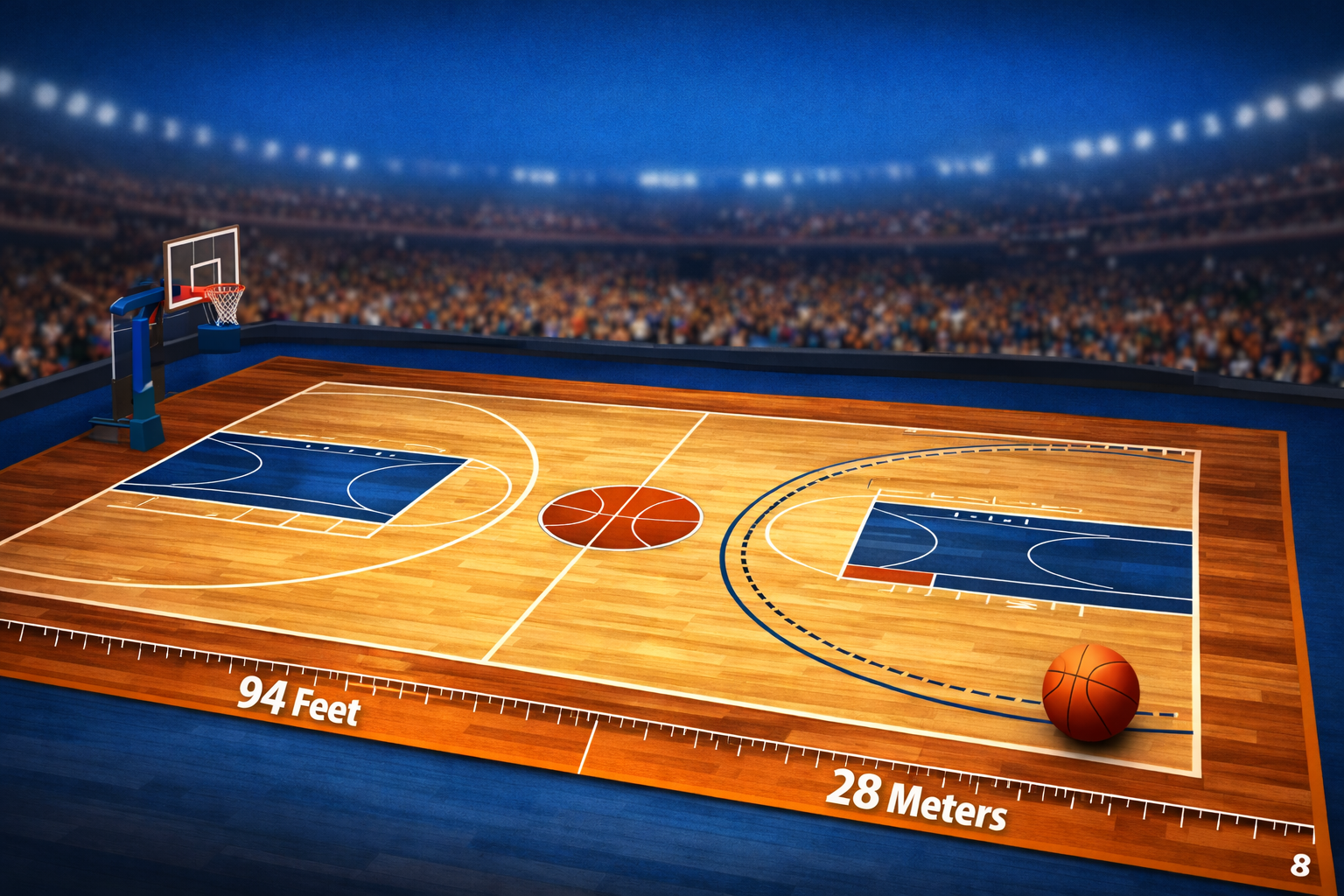
A full-size court uses these common standards:
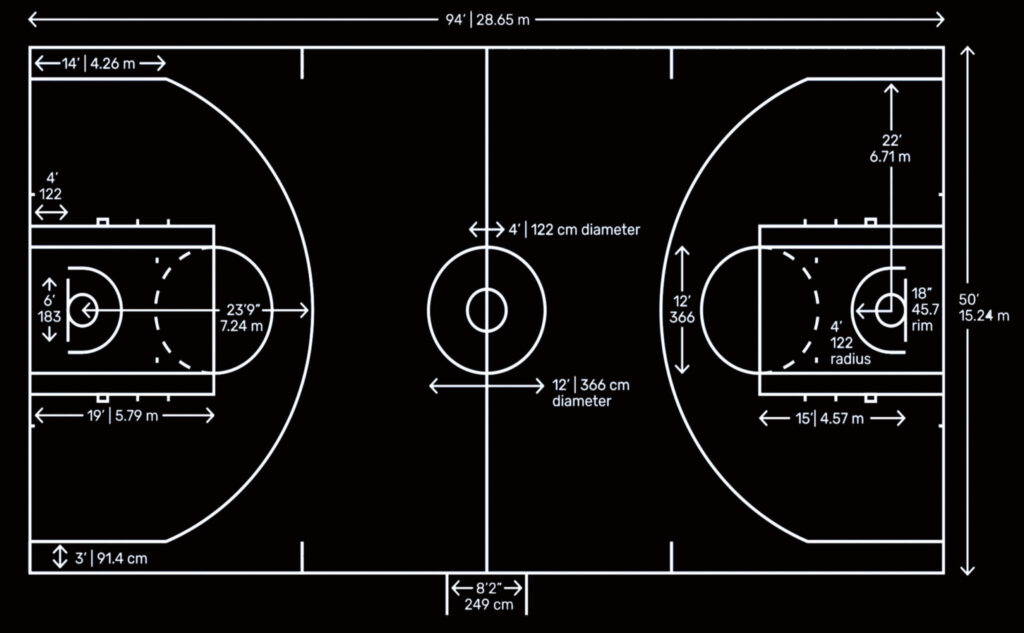
- NBA and NCAA: 94 ft by 50 ft (28.65 m by 15.24 m)
- FIBA (international): 28 m by 15 m (91 ft 10.4 in by 49 ft 2.6 in)
- High school (often in the US): 84 ft by 50 ft (25.60 m by 15.24 m)
Those numbers define the playing area inside the boundary lines. People often mix this up with the full floor area, which should include extra space beyond the lines for safety.
Why basketball court size changes between leagues
Leagues set court measurements to match their style of play and player skill. A longer court rewards speed in transition. A wider court creates cleaner driving lanes and kick-out threes. Small shifts also change angles on closeouts and help defense.
A court can feel “tight” even when it stays full size. Teams that pack the paint and switch often make space feel smaller, but the lines never moved.
NBA dimensions: the pro baseline most people copy
If you want the most requested spec sheet, use NBA dimensions.
- Court length: 94 ft
- Court width: 50 ft
- Rim height: 10 ft (3.05 m)
- Backboard: 6 ft wide by 3.5 ft tall (1.83 m by 1.07 m)
The NBA court gives you the reference point that many gyms use, even outside pro arenas.
Key lines and areas on a standard court
The rectangle matters, but the markings control how the game flows. These are the lines builders measure twice.
The center circle and midcourt line
The midcourt line splits the floor into two halves. The center circle sits on midcourt.
- Center circle radius (common): 6 ft (1.83 m)
Many courts follow this radius, and you will see it across levels.
The free throw line and lane
The free throw line anchors the lane and sets post spacing.
- Free throw line distance: 15 ft (4.57 m) from the backboard
- Lane length: 19 ft (5.79 m) from baseline to free throw line
Lane width changes by league:
- NBA lane width: 16 ft (4.88 m)
- NCAA and most high school lanes: 12 ft (3.66 m)
- FIBA lane width: 4.9 m (about 16 ft 1 in)
That lane-width difference changes everything for post play. Wider lanes reduce deep seals and open more space for drives and cuts.
The three-point line
This line drives modern spacing more than any other marking. Distances vary a lot, so confirm your target league before you paint.
Common three-point standards:
- NBA: 23 ft 9 in at the top, 22 ft in the corners
- NCAA men: 22 ft 1.75 in (6.75 m)
- FIBA: 6.75 m (22 ft 1.75 in)
- US high school (typical): 19 ft 9 in
Corner distance matters since the sideline forces a shorter arc. That is why corner threes feel different even for elite shooters.
The restricted area and the basket location
Under the rim, leagues mark a no-charge zone to guide contact calls.
- Basket location: 4 ft (1.22 m) from baseline to backboard face
- Restricted area arc (NBA): 4 ft radius from the rim center
Other leagues may use a similar arc, but you should check the rule set you plan to host.
Court measurements you must get right for a playable build
Some mistakes do not show up until people start running.
Line width
Most courts paint lines at a consistent thickness.
- Typical line width: 2 in (5 cm)
Consistency matters more than the exact number, so keep every marking the same width.
Distance from sideline to the three-point corner
This detail controls if your corner three fits cleanly. If the corner space gets tight, painters sometimes cheat the curve. That creates odd angles and disputes later.
If you plan for NBA dimensions, keep the corner straight section aligned so the corner distance stays true.
The out-of-bounds safety area
Do you need extra space beyond the boundary lines? Yes, and you should treat it as part of the build. Players sprint and slide past the lines at full speed, so give them room.
A practical target for many gyms is 6 ft to 10 ft of clear space on all sides. Pro venues often exceed that. Small community builds may have less, but risk rises fast.
How to choose the right basketball court size for your gym or club
Start with your main user group. Pick one rule set, then commit to it.
- Build for NBA dimensions if you host adult leagues and serious training.
- Build for FIBA if you host international play or FIBA-rule events.
- Build for high school if your school league uses that spec.
If you share the gym across groups, you can add multiple three-point lines. Use distinct colors, and keep contrast high. Players read the floor in motion, and cluttered paint causes real confusion.
Quick reference: common basketball court size options
These headline numbers help you sort plans fast.
- NBA and NCAA court: 94 ft by 50 ft
- FIBA court: 28 m by 15 m
- High school court (common): 84 ft by 50 ft
- Rim height: 10 ft
- Free throw line: 15 ft from the backboard
That covers the skeleton of most court measurements.
One question that saves expensive repainting
Can you mix NBA dimensions with a high school three-point line and call it done? Yes, and many facilities do exactly that. The layout still works, but coaches should label which line counts for each game format.
Final checks before you tape or paint
Walk the site and mark your true usable area first. Confirm your baseline-to-wall distance. Then set your basket locations, and only then snap the rest of the lines.
A well-built court feels “right” the first time players run it. The spacing stays honest, the angles look clean, and every possession fits the rules you claim to play.