Youth football is not about copying professional systems. It is about development. The right structure helps players learn spacing, decision-making, and teamwork.
Many coaches rush into complex systems. That creates confusion. Young players need clear roles and simple patterns. The best youth soccer formations teach the game step by step.
This guide explains how to choose and use formations that match age, skill level, and learning goals.
Why Formations Matter in Youth Soccer
A formation gives players structure. It shows where to stand and how to move. Without it, the game turns into chaos.
Young players often chase the ball. A formation creates balance. It spreads players across the field and builds awareness.
Formations also shape habits. A child who learns positioning early will read the game better later. This affects passing, defending, and movement off the ball.
Coaches should not treat formations as rigid systems. They should use them as teaching tools.
Key Principles Before Choosing a Formation
Before picking any system, focus on a few core ideas.
Spacing: Players need distance between each other. This creates passing options.
Support: Every player should have at least two options when they receive the ball.
Balance: The team must cover both sides of the pitch.
Simplicity: Young players learn faster with clear roles.
These principles matter more than the formation itself. A simple system with good spacing beats a complex system with confusion.
4v4: The Foundation Stage
At ages 6 to 8, small-sided games work best. The 4v4 format gives each player more touches.
Basic shape:
- 1 defender
- 2 midfielders
- 1 forward
This setup teaches core skills. Players learn to attack and defend in equal measure. There are no fixed positions, so every player develops all aspects of the game.
The field is small, so decisions happen fast. Players improve control, passing, and awareness.
Coaches should rotate positions often. This prevents early specialization.
7v7: Introducing Structure
At ages 9 to 11, players start to understand shape and roles. This is the stage where youth soccer formations begin to matter more.
2-3-1 formation:
- 2 defenders stay compact and protect the center
- 3 midfielders spread wide and support both attack and defense
- 1 striker stays high and looks for space behind defenders
This system creates natural triangles across the pitch. It gives passing options in every area. The wide midfielders stretch the field, and the central midfielder links play.
In training, focus on how the midfield three move. When the ball goes wide, the far-side midfielder must tuck in. This keeps the balance.
3-2-1 formation:
- 3 defenders provide cover and width at the back
- 2 midfielders connect defense to attack
- 1 striker leads the line
This setup suits teams that struggle defensively. The extra defender adds security. It also allows full-backs to step forward with the ball.
In matches, teach the outside defenders to carry the ball forward. This creates overloads in midfield and builds confidence in possession.
Both systems work well, but the 2-3-1 gives more attacking freedom. The 3-2-1 gives more defensive stability. Choose based on your players.
9v9: Building Tactical Awareness
At ages 11 to 13, players face more space and more decisions. Formations must support both attack and defense.
3-3-2 formation:
- 3 defenders hold a compact line
- 3 midfielders control the center
- 2 forwards create constant pressure
This system encourages attacking play. The two forwards can combine and make runs in behind. Midfielders must work hard to support both sides of the game.
Teach midfield rotation. When one player pushes forward, another must cover. This builds awareness and responsibility.
4-3-1 formation:
- 4 defenders form a solid back line
- 3 midfielders manage possession
- 1 striker stays central
This shape prepares players for 11v11 football. It builds defensive discipline and positional understanding.
Full-backs must learn timing. They should join attacks but recover quickly. Midfielders must stay connected, not spread too far apart.
At this level, introduce simple tactics. Teach when to press, when to drop, and how to keep shape without the ball.
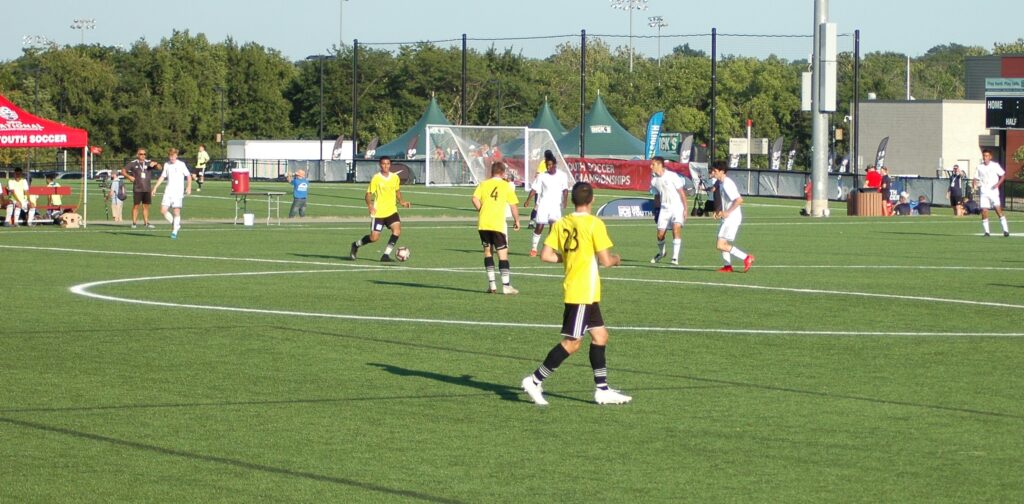
11v11: Preparing for the Full Game
From age 13 and above, players move into full-size football. Formations become more detailed.
Common soccer tactics youth coaches use:
4-3-3:
- 4 defenders
- 3 midfielders
- 3 forwards
This system teaches width and pressing. Wingers stretch the field, and midfielders control tempo.
4-4-2:
- 4 defenders
- 4 midfielders
- 2 forwards
This shape is simple and balanced. It is easier for beginners to understand.
4-2-3-1:
- 4 defenders
- 2 holding midfielders
- 3 attacking midfielders
- 1 striker
This setup introduces advanced roles. It suits older youth players with strong awareness.
Coaches should match the formation to player ability. A complex system fails if players cannot execute it.
Adapting Formations to Player Development
Every team has different strengths. A formation must reflect the players on the pitch.
Start by identifying key traits. Look at pace, control, awareness, and confidence. These factors shape your decisions.
If your team has fast wide players, use systems that create space on the flanks. In a 2-3-1, push wide midfielders higher. Give them freedom to attack.
If your team has strong central players, keep the shape narrow. Use midfield triangles to control possession through the middle.
If defenders lack confidence, add support. A back three in 7v7 or 9v9 gives more cover and reduces pressure.
Rotation is critical at younger ages. Players should experience different roles. A defender should try midfield. A striker should learn to defend.
This builds complete players. It also helps them understand the game from multiple angles.
Adjust during the season. If a system stops working, change it. Development is not fixed. It evolves with the players.
Common Mistakes Coaches Make
Many coaches focus on the wrong details. This slows player development.
One major mistake is forcing rigid positions. Young players need freedom to move and explore. Locking them into zones limits creativity.
Another mistake is copying professional systems. A 4-3-3 at the senior level relies on advanced movement and awareness. Young players cannot execute these patterns yet.
Some coaches chase results over learning. They pick defensive systems to win games. This limits attacking growth and decision making.
Poor communication is another issue. Long explanations confuse players. Clear, short instructions work better.
Ignoring spacing is a frequent problem. Players bunch together and lose structure. Coaches must correct positioning constantly during training.
Training without context also fails. Running drills without game situations does not build understanding. Players need to see how movements apply in matches.
Fix these mistakes early. Good habits formed at a young age last for years.
How to Teach Formations Effectively
Teaching formations requires clear steps and repetition. Players must see and feel the shape.
Start with a walk-through. Place cones to mark positions. Show each player where to stand. Then move the ball and adjust positions step by step.
Break the formation into small units. Work with defenders first. Then midfielders. Then connect the whole team.
Use small-sided games to reinforce learning. For example, play a 4v4 game inside a 7v7 shape. Focus on spacing and support.
Give players simple rules:
- Stay wide when your team has the ball
- Stay compact when defending
- Move after every pass
These rules guide decision-making without overloading players.
Use repetition. Run the same pattern several times. For example, practice building from the back with defenders and midfielders. Repeat until movements become natural.
Ask short questions during sessions. For example, where should you move after passing? The answer is simple. Move into space to support the next action.
Correct mistakes in real time. Stop the drill, adjust positions, and restart. Immediate feedback improves learning speed.
Keep sessions active. Limit long talks. Let players learn through movement and repetition.
Clear teaching builds confident players. Confident players understand formations and apply them in matches.
Final Thoughts
Youth soccer formations are tools for learning. They help players understand space, movement, and teamwork. Keep systems simple. Focus on development. Adjust based on your players.
A well-coached 2-3-1 at age 10 builds better habits than a complex system forced too early. Teach the basics well. Build strong habits. The results will show as players grow into the full game.